
Is Coin Parking Profitable? Explaining the Revenue Structure and How to Start Without Failing
Many landowners who have inherited land or have unused vacant lots may be interested in coin parking as a way to put their land to use.
However, we often hear that people cannot quite take the first step due to concerns such as "Will it really be profitable?" or "What if I set one up and end up in the red?"
This article explains how coin parking generates profit, what conditions make land profitable, and how to get started without failing.
Table of Contents
Is Coin Parking Actually Profitable?
Whether coin parking is profitable depends on the conditions of the land and how it is operated.
First, let us organize the background behind the concerns many owners have and the key concepts that determine profitability.
More Landowners Are Worried About Whether Their Business Will Succeed
An increasing number of landowners are burdened with inherited land or idle lots, bearing only maintenance costs.
Simply owning land incurs fixed asset taxes and city planning taxes, and leaving it unused without generating revenue risks turning it into a "liability" where costs keep accumulating.
In this context, coin parking has been chosen as a low-risk option that requires no building construction and can make use of small or irregularly shaped lots.
However, since "placing one does not guarantee profit," it is important to understand the key considerations before moving forward.
There Are "Profitable Lots" and "Unprofitable Lots"
The revenue from coin parking is determined by a combination of multiple factors: location, occupancy rate, pricing, operating costs, and taxes.
In other words, profitability is determined not by "being a coin parking lot" but by "the specific land and how it is operated."
In the following sections, we break down the revenue structure, conditions that make land profitable, and causes of poor profitability in order, so you can assess whether your own land meets the conditions for success.
How Coin Parking Generates Profit
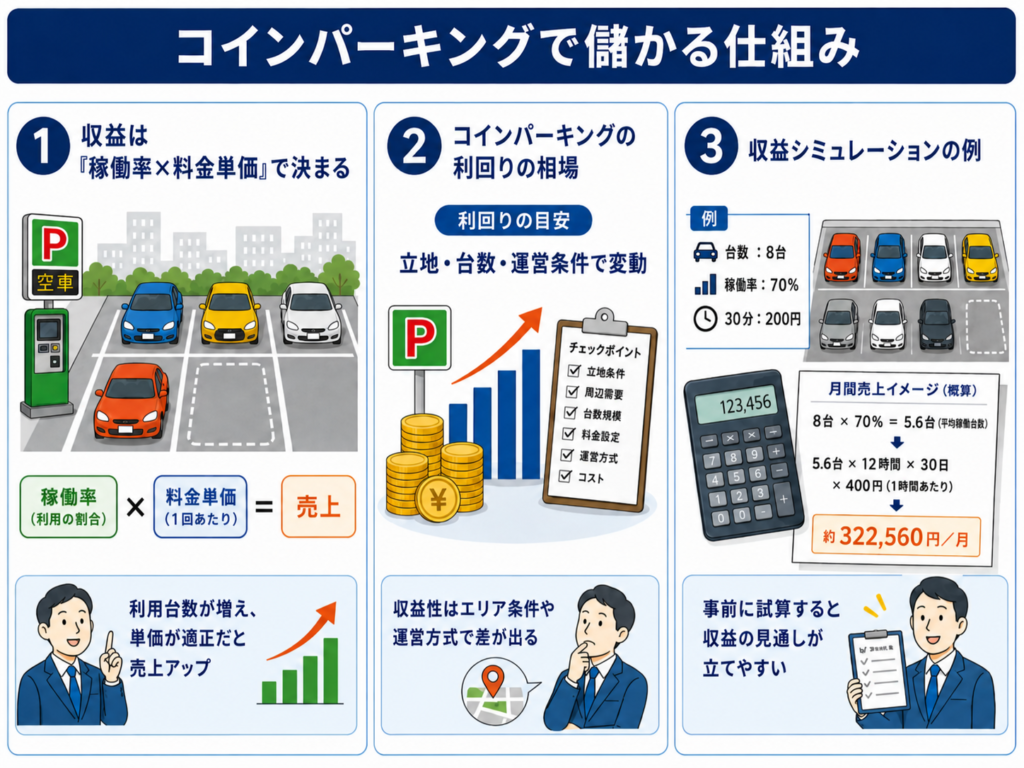
Understanding how coin parking revenue is generated is the first step in making an informed decision.
Here we organize the revenue structure, typical return rates, and how to think about revenue simulations.
Revenue Is Determined by "Occupancy Rate × Rate per Unit"
Coin parking revenue is structured as "occupancy rate × rate per unit × number of spaces."
Of these factors, the occupancy rate typically ranges around 50–70%, varying by pricing and number of spaces, but it is characterized by significant fluctuation depending on time of day and day of the week.
Peak demand varies by location—weekday daytime in office districts and residential areas, evenings and weekends in entertainment districts.
When considering the financials, it is important not to assume the lot will always be full.
Conditions That Make Land Profitable for Coin Parking
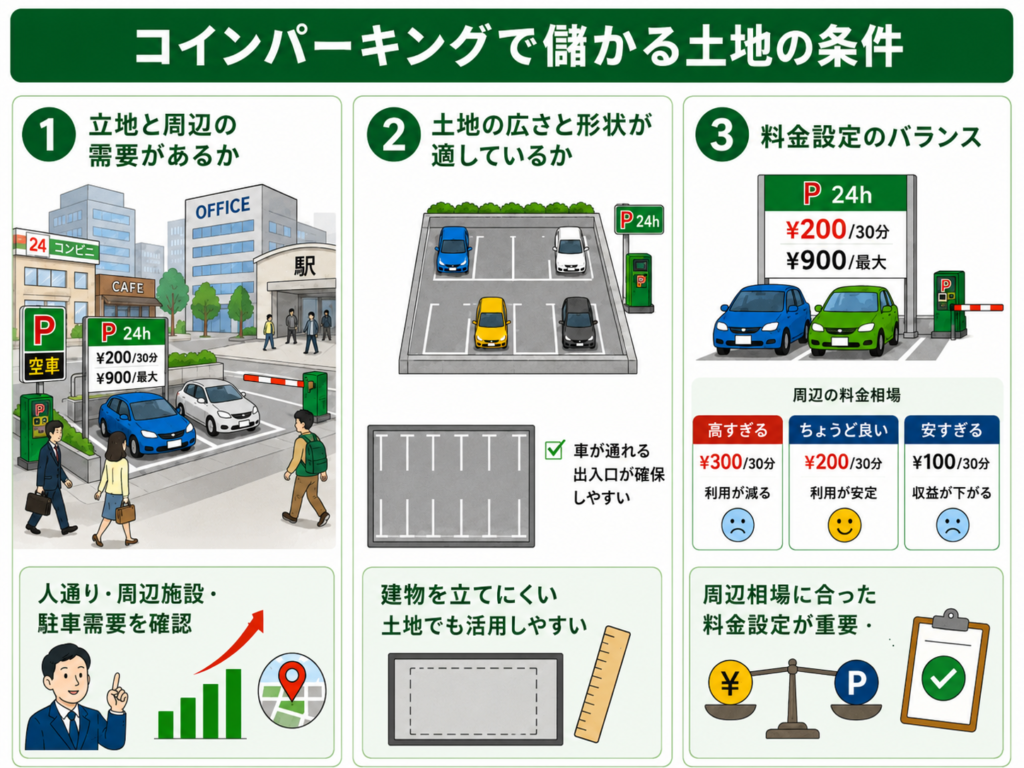
Even with the same coin parking setup, revenue can vary greatly depending on the land's conditions.
Here we outline three conditions to help identify land that is likely to be profitable.
① Is There Demand Based on Location and Surroundings?
Locations such as entertainment districts, areas near train stations, and vicinities of commercial facilities attract many people and vehicles, making high short-term parking demand and occupancy rates achievable.
On the other hand, even in residential areas, if there is a consistent short-term parking need—such as for visitors, nearby shops, or business vehicles—generating revenue is entirely possible.
Generally, a frontage of 3–3.5 meters along the road in front of the land is sufficient, but having 5 meters or more makes vehicle entry and exit smoother and easier to use.
Rather than the location itself, the key point is whether there is parking demand at that particular spot.
② Is the Size and Shape of the Land Suitable?
Coin parking can be started with a minimum of about 10 tsubo (approximately 33 square meters), enough space for 2–3 vehicles.
Unlike apartments or condominiums, one advantage is that land that is difficult to build on—such as triangular or elongated lots—can still be put to use.
In fact, land that is difficult to develop with buildings tends to be particularly well-suited for coin parking.
Land that was difficult to utilize in other ways can often become an advantage as a parking lot.
③ Balance of Pricing
Revenue is determined by both "occupancy rate × rate per unit," so pursuing only one of the two has its limits.
For example, if the maximum rate is set too low, long-term parking increases and turnover drops.
Conversely, if it is too high, short-term daytime users will go elsewhere.
Therefore, reviewing rates in small increments based on occupancy data can boost overall revenue.
Reasons Why Coin Parking Lots Are Not Profitable
While there are conditions that lead to profitability, pitfalls that squeeze revenue also exist.
Here we organize the reasons for low profitability into three structural categories.
① Overestimating the Occupancy Rate
A financial plan premised on near-full capacity can lead to deficits due to the gap with actual occupancy.
In particular, basing projections on special-demand days such as festivals or school events causes you to overlook vacancies during normal times.
As a countermeasure, it is advisable to estimate occupancy by time slot and day of the week conservatively, and to determine in advance the break-even point — how long vacancies can continue before falling into the red.
It is important to assess whether the operation is profitable based on everyday occupancy, not just a few peak days per year.
② Unable to Receive Tax Reduction (Residential Land Special Exception)
Land used for a coin parking lot is treated as "bare land" and is therefore not eligible for the residential land special exception (a system that reduces fixed asset tax by up to 1/6).
As a result, the full assessed value is taxed, reducing the net income accordingly.
Those with experience in apartment management in particular may plan their finances assuming a tax reduction, only to find that profits fall short of expectations, so caution is needed.
Be sure to factor taxes into your financial simulation.
③ Competitors Tend to Emerge Easily
Because coin parking lots have low initial costs and are easy to enter, competitors tend to appear in the vicinity.
The more popular the area, the more competitors are likely to emerge, and if a price war develops, there is a risk that occupancy rates and revenue will decline.
How to Start a Coin Parking Lot Without Failing
There are three methods of operating a coin parking lot: self-management, management outsourcing, and bulk lease.
Comparing the differences in effort, profitability, and risk yields the following.
| Management Method | Profitability / Monthly Revenue Characteristics | Risks / Notes |
| Self-Management | [Variable / High Revenue] Depending on occupancy rate, high revenue exceeding a monthly contract is possible. | [Risk of Deficit] In months with few users, revenue decreases and there is a risk of operating at a loss. |
| Management Outsourcing | [Variable Income] Revenue is the amount remaining after deducting the management outsourcing fee from sales. | [Outsourcing Fee Incurred] Take-home pay varies depending on occupancy rate, outsourcing fee, and contract terms. |
| Bulk Lease | [Stable Income] A fixed monthly rent is guaranteed every month. | [Low Risk] Not affected by daily occupancy, greatly reducing concerns about vacancies or declining sales. |
Note that contract conditions and revenue may differ from the above depending on the location and condition of the property.
Among these, the bulk lease method has the operating company cover initial costs and running costs, allowing you to receive stable rent unaffected by occupancy.
Everything from equipment installation to cash collection, maintenance, and trouble handling is entrusted to the operator, making it suitable for first-time operators or those who want to minimize the hassle.
It is also a suitable method when the land is in a remote location or when you want to avoid vacancy risk as much as possible.
If You Are Considering Coin Parking Lot Management, Please Consult Eiko Renta Service
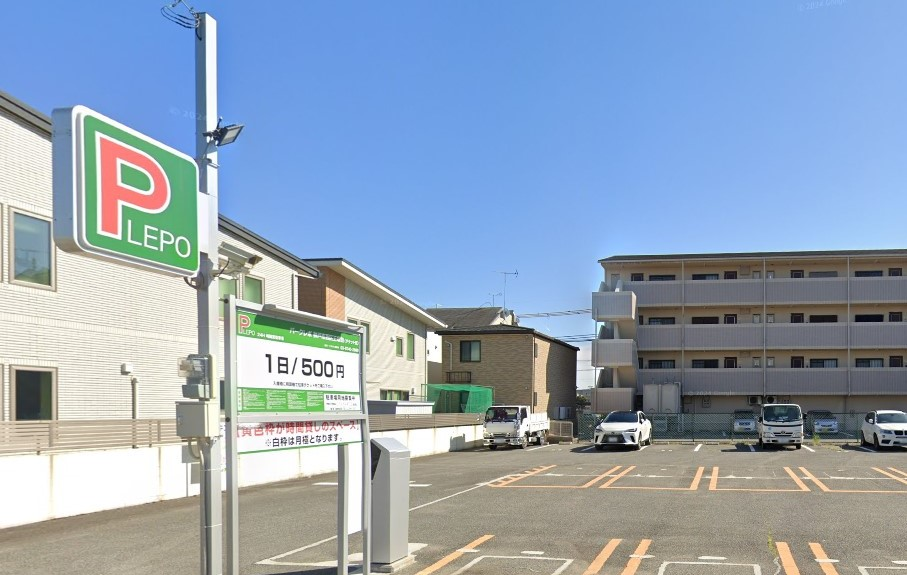
For those who want to earn stable revenue from a coin parking lot but want to avoid occupancy risk and management hassle, the bulk lease service "Park LEPO" by Eiko Renta Service is an ideal solution.
With Park LEPO, all costs associated with parking lot management — from installing equipment such as payment machines and signage to running costs such as security, cash collection, cleaning, and consumables — are covered entirely by our company.
The initial cost to the owner is effectively zero, allowing you to start coin parking lot management without any outlay for equipment or construction.
Because the rent is a fixed system not subject to the parking lot's sales, income does not change even if the occupancy rate drops.
The contract renewal rate is 99.3% (fiscal year 2024 results), and we have particular strength in land utilization in residential areas, which are considered commercially challenging.
Please feel free to start with a free consultation and free appraisal to find out how much rent you can expect from your land.
Testimonials from Customers Who Have Used Eiko Renta Service
Here we introduce testimonials from customers who have actually used Eiko Renta Service.
Successfully Increased Rent by Switching from Another Company
We transitioned from a privately managed monthly parking lot to a coin parking lot, and all management hassle has completely disappeared. Thanks to the attentive support of the person in charge and the peace of mind from a fixed rent paid reliably every month, we have maintained a long relationship of 6 years.
Peace of Mind from a Reliable Representative and Stable Income
When a price reduction negotiation with another company prompted me to consult Eiko Renta Service, I received a proposal with a higher rent and decided on the spot. The switching process was smooth, the on-site cleaning improved, and I am truly satisfied.
Learn more about coin parking lot management with Eiko Renta Service
Summary
Whether a coin parking lot is profitable depends not on "being a coin parking lot" per se, but on the land and how it is operated.
Revenue is composed of "occupancy rate × rate per unit × number of spaces," and land where the demand from location, the size and shape of the land, and the balance of pricing align is more likely to be profitable.
On the other hand, three causes lead to unprofitable outcomes: overestimating the occupancy rate, increased tax burden due to ineligibility for the residential land special exception, and the increase in competition.
To avoid these pitfalls, it is important to conduct realistic simulations and choose a management approach that minimizes risk.
In particular, bulk leasing—which requires virtually no initial costs and provides stable rental income regardless of occupancy—is a suitable option for those who want to reduce the risk of failure.
With Eiko Renta Service's "Park LEPO," we cover all equipment costs and running costs, and we also support land utilization in residential areas.
If you are curious whether your land meets the conditions for profitability, please feel free to check with a free consultation or free assessment.